




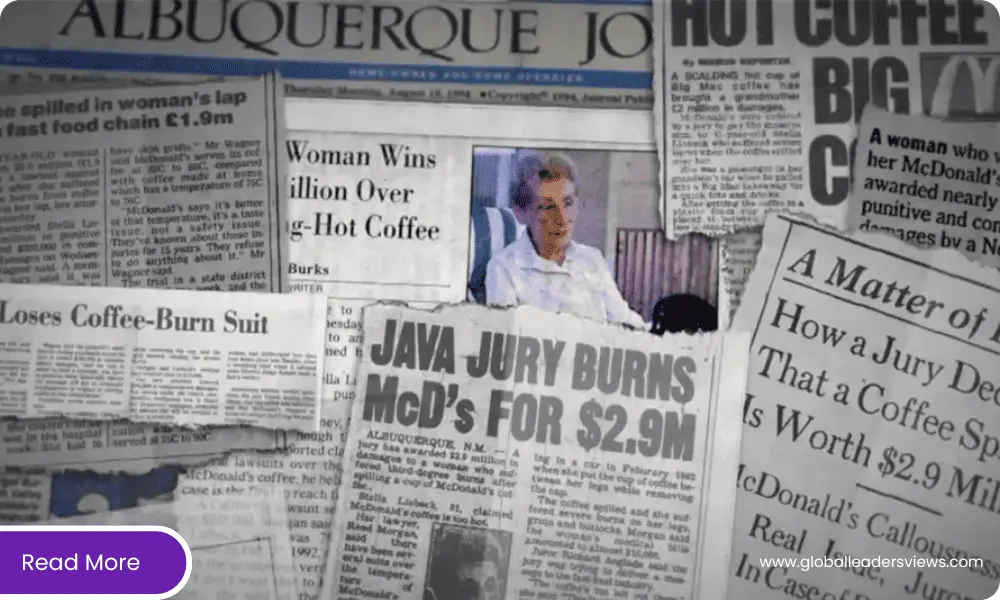
The 1994 case Liebeck v. McDonald’s Restaurants is frequently viewed as a joke about a woman pouring coffee on herself. However, for today’s legal leaders, particularly those influencing laws, corporate strategy, and litigation in 2026, this case remains one of the most significant product liability decisions in contemporary US legal history.
At its heart, the case was never about carelessness. It was about corporate responsibility, consumer safety, and how the law reacts when a firm intentionally overlooks risk.
What Really Happened and Why It Matters
Stella Liebeck, a 79-year-old client, got serious third-degree burns after spilling McDonald’s coffee, which was served at temperatures ranging from 180 to 190°F. The evidence produced in court revealed that McDonald’s had received hundreds of earlier complaints about burns from its coffee but opted not to lower the temperature. Internal documents revealed that the corporation was aware of the risk but decided that filing a lawsuit was less expensive than changing its methods.
For today’s the law, this highlights an important principle: foreseen harm paired with inaction can result in gross negligence. In an era where businesses rely on data, analytics, and internal reporting, courts are increasingly expecting decision-makers to take action on identified risks.
A Turning Point in Product Liability Law
The jury’s decision sent a strong message: large corporations are not immune from accountability simply because a product is common or widely accepted. The punitive damages, though later reduced, were meant to reflect McDonald’s daily coffee profits—underscoring that penalties must be meaningful enough to change behavior.
In 2026, this lesson is more relevant than ever. From AI-driven products to consumer health goods and autonomous technologies, courts continue to ask the same question raised in Liebeck: Did the company know the risk, and did it choose profit over safety?
Why Legal Leaders Still Study This Case
For judges, regulators, general counsels, and policy leaders, Liebeck v. McDonald’s is a case study in:
- Risk management failure
- The power of internal evidence
- The purpose of punitive damages
- How public narratives can distort legal truth
It also reminds legal professionals that jury decisions often reflect community standards, not corporate logic. Understanding public perception and ethical responsibility is now as important as understanding statutes and precedents.
The impact of Liebeck v. McDonald’s on history
Decades after the notorious 1994 case, Liebeck v. McDonald’s restaurants continues to be a major topic of conversation on consumer rights, corporate responsibility, and product safety. What many initially wrote off as a strange case has turned into a crucial lesson for companies navigating a world of hyper-awareness, social media criticism, and real-time customer feedback.
Technology and consumer safety
Companies can now proactively prevent events like hot beverage burns using AI-powered risk management, IoT-enabled product monitoring, and automated quality control. However, Liebeck’s instance serves as a reminder that technology isn’t sufficient on its own; accountability culture, safety procedures, and clear labeling are just as important. The legacy of the lawsuit influences how companies strike a balance between innovation and human safety as they compete in marketplaces that are becoming more automated and digitalized.
directing the expectations of contemporary consumers
Customers’ expectations are still impacted by the case: open communication, recourse, and business ethics are now more important than ever in fostering loyalty. The concepts emphasized by Liebeck’s experience serve as a reference for contemporary product design, risk reduction, and business decision-making in anything from driverless delivery trucks to smart kitchens.
A business strategy for the future
In summary, the McDonald’s hot coffee case is not merely a piece of history; rather, it serves as a roadmap for the future, guiding ethical business practices and protecting consumers in 2026 and beyond.
A Lasting Lesson for 2026 and Beyond
The fundamental legacy of the McDonald’s hot coffee case is not about coffee, but about business decisions. Legal leaders today face increased transparency, social accountability, and immediate public criticism. The Liebeck case shows how ignoring minor warnings can result in major legal consequences.
For modern legal leadership, the message is clear: safety is not a cost, it is a duty. And when that duty is ignored, the law will respond.









Leave a comment