





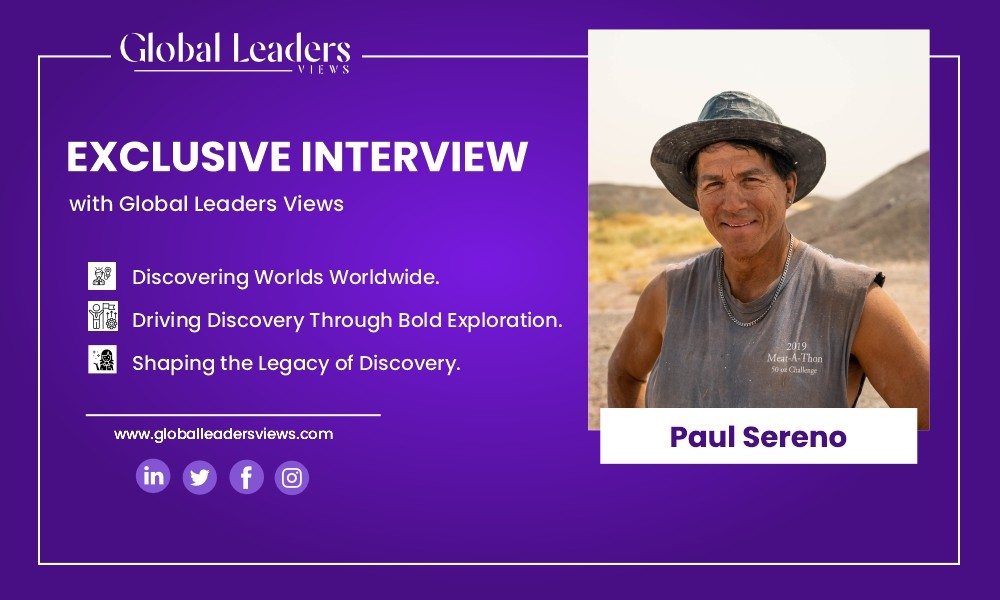
For most people, discovering a new dinosaur would be the achievement of a lifetime. For Paul Sereno, dozens of new species mark a globe-trotting career driven by exploration, scientific discovery, education, and a relentless desire to understand worlds that vanished millions of years ago. A renowned paleontologist, archaeologist, explorer, and professor at the University of Chicago, Sereno has spent decades venturing into some of the most remote and challenging landscapes on Earth, uncovering remarkable creatures and lost civilizations that have transformed our understanding of history.
Yet when speaking about his life’s work, he does not begin with these discoveries, the numerous awards he has received, or the multiple times his research has appeared on the cover of the prestigious journal Science. Instead, he speaks first about his passion for the legacy he hopes to leave for future generations.
“I love adventure and discovery,” Sereno says. “Paleontology is an irresistible combination of science, adventure, and visualization. In many ways, a paleontologist is a time traveler. You must find things lost in time that have never been seen before and then visualize them to bring them alive.”
An insatiable sense of wonder has remained the driving force behind a career that has taken Paul Sereno from the foothills of the Andes Mountains to the vast sand seas of the Sahara Desert, from mountainsides in Tibet to the parched steppe of the Gobi Desert.
Yet something deeper, a sense of purpose, has always been at work. Each discovery contributes to a legacy that extends beyond the explorer. Today, that legacy is reflected in his Fossil Lab located in a Chicago neighborhood, his plans for a novel science center nearby, and his designs for zero-energy museums in Africa.
From Struggling Student to Aspiring Artist to World-Renowned Explorer
Long before he became one of the world’s most celebrated paleontologists, Paul Sereno was a student who struggled in school, growing up in Naperville a suburb of Chicago. Reading a dictionary to improve a limited vocabulary, he headed to college with a determination to find his place.
He was drawn to art, influenced by his mother, a highly respected art teacher who nurtured his creative talents. At the same time, his father, a self-taught civil engineer, instilled a broad perspective that included scientific curiosity.
As an undergraduate at Northern Illinois University, Sereno embraced both art and biology. He painted large canvases while exploring the life sciences, uncertain where his path might ultimately lead. That blend of art and science would later become one of his greatest assets, helping him find fossils hidden on remote landscapes and bring them back to life in images, film and mounted skeletons.
Everything changed when he arrived in New York. The trip was not to visit an art studio as initially planned but to tag along with his brother on a tour of the American Museum of Natural History. Unlike the passing interest of many visitors, Sereno was awestruck by what he saw in the halls filled with extinct creatures and the fossils stored behind the scenes. In that moment, he saw a career immersed in travel and discovery. He imagined a life of adventure, visualizing extinct creatures through the eyes and hands of an artist.
“I never recovered from that visit,” he recalls. “In paleontology, I saw an irresistible combination of travel, adventure, art, biology, and geology, and I would eventually understand that paleontology would also provide the opportunity to leave the world a better and more interesting place.”
After earning his doctorate from Columbia University in 1987, Sereno joined the University of Chicago. While many academics build careers primarily in classrooms and laboratories, Sereno came to a grander vision, seeking to explore places where few scientists had ventured in search of worlds no one had seen.
Stepping into the wild as a young scholar, his came to understand that great discoveries were to be found where few have looked.
As the cover face of Top 10 High-Impact Speakers Driving Growth & Leadership in 2026, Paul Sereno stands apart as an explorer, scientist, and storyteller whose work has inspired audiences around the world. From uncovering lost worlds beneath the sands of the Sahara to bringing ancient history to life through technical papers and powerful presentations, Sereno’s driven career will leave behind a legacy of new creatures, novel institutions, and generations of inspired minds. His journey proves that some of the most impactful leaders arise from truly humble beginnings and ultimately leave a legacy that inspires others to see beyond the horizon.
The First Dinosaurs Discovered
Sereno’s early expeditions led him to Argentina, where bones of the oldest dinosaur fossils had come to light in the rugged landscapes in the foothills of the Andes. Working in the field with a young team leading his first expedition, Paul Sereno spotted a complete skull of the early dinosaur Herrerasaurus. The centerpiece of his first paper in the leading journal Science, the find would play a pivotal role in understanding dinosaur origins.
Soon afterward, his team uncovered Eoraptor, meaning “dawn raptor,” and an ash bed that dated the earliest dinosaurs to approximately 230 million years ago. Another landmark discovery followed with Eodromaeus (“dawn runner”), a small dinosaur that provided additional insight into the earliest stages of dinosaur evolution. Together, these discoveries offered scientists a clearer picture of how dinosaurs first emerged and diversified in Late Triassic times.
For Sereno, however, the excitement extended far beyond the science. Every new find is a direct connection to worlds never visited. The challenge was not simply uncovering bones but reconstructing life and the majestic transformations that unfolded in deep time. All from clues preserved in stone in remote locales.
His artistic background and writing skills proved invaluable in documenting new species and bringing them to life for the public. By combining scientific rigor with written and visual storytelling, Sereno helped bridge the gap between technical research and public understanding, enabling audiences to imagine creatures and worlds that existed hundreds of millions of years before humans evolved.
Navigating Saharan Sand Seas and Uncovering Africa’s Lost World
While his discoveries in South America established his reputation, it was Africa that would become the defining work of Paul Sereno’s career. Beginning in the early 1990s, he launched a series of ambitious expeditions into the Sahara Desert, one of the most challenging and unexplored landscapes on Earth.
The expeditions required extensive planning and logistics, immense mental and physical endurance, and a willingness to face unexpected hurdles and extreme conditions. In temperatures sometimes exceeding 120° F, he and his teams hauled out multi-ton field jackets encasing the bones of enormous reptiles new to science. The rewards proved extraordinary.
Over the course of several decades, Sereno and his colleagues excavated more than one hundred tons of fossils, revealing a Jurassic and Cretaceous menagerie unlike anything previously imagined. They discovered long-necked herbivores such as Nigersaurus, whose unusual skull and hundreds of teeth challenged conventional ideas about dinosaur feeding strategies. They also uncovered predators including Afrovenator and Rugops, providing new clues about the evolution of carnivorous dinosaurs on a continent adrift.
Among the most famous discoveries was Suchomimus, a giant huge-clawed predator whose crocodile-like snout hinted at its specialized fish-eating diet. Then came Sarcosuchus, the enormous crocodile Sereno famously nicknamed “SuperCroc,” measuring some thirty feet long. Weighing as much as five tons, it became one of the most recognizable prehistoric animals ever discovered.
The Saharan expeditions transformed scientific understanding of Africa’s dinosaur diversity, underscoring how much remained to be discovered in far flung regions of the world. For Sereno, the Sahara brought meaning to his understanding that extraordinary discoveries are found where few have ventured.
People of the Green Sahara: Gobero Discovered
By the year 2000, Paul Sereno had already established himself as one of the world’s leading paleontologists. His discoveries of dinosaurs, giant crocodiles, and prehistoric predators had earned international recognition. Yet one of the most profound discoveries of his career would not involve dinosaurs at all.
While looking for Mesozoic-age creatures in the vast expanse of the Sahara Desert, Sereno came across something unexpected—burials of fossilized humans. And not just a few. Hundreds of burials in a place known as Gobero composed remains soon revealed themselves to be one of the most significant archaeological sites ever discovered in Africa. The site, which he named Gobero, would eventually challenge what archaeologists understood about how humans adapted to life in the Sahara thousands of years ago.
Today, endless dunes, scorching temperatures, and limited water define the Sahara, where impassable sand seas divide the landscape. But Gobero told a very different story. Thousands of years ago, the region was dotted by lakes with fish visited by all manner of hoofed animals, hippos and crocodiles. Gobero was special, with freshwater springs that kept its lake filled and wild animals abundant and near. Communities settled there for the long haul, over five thousand years, living in balance with nature.
Among the discoveries was one that captured global attention. Dubbed the “Stone Age Embrace,” the burial preserved the skeletons of an adult woman and two young children. Their skeletons with hands intertwined was a powerful image of human intimacy transcending time.
Another burial, some 8,000 years old and soon to be announced, “Mother and Newborn,” preserves a mother holding in her arms her just-born child, buried together with care in death. These discoveries resonate beyond the scientific community, because they remind us that the emotions that charcaterize humanity today have a pedigree reaching back thousands of years.
For Sereno, Gobero captured something special in the archives of archaeology. Here was a society that lived in harmony with its environment for more than five thousand years. Their story serves as a powerful reminder that sustainable living, something we are struggling to come to terms with today, is actually something we achieved in the distant past.
“Science and our deep past give us perspective,” Sereno explains. “We may live in the present, but the choices we make today will shape the world future generations will inherit.”
Leadership by Example with Empathy
When dinosaur discoveries and archaeological breakthroughs are announced, it is natural to focus on the moment of discovery and sometimes overlook years of preparation and planning or later research required to bring them to life. Success in the field, in particular, demands resilience, patience, and an unwavering commitment to a shared goal —making an impact that will last.
Spearheading expeditions in remote and unfamiliar regions is no small undertaking. Beyond scientific expertise, it requires attention to detail, planning, adaptability, collaboration, and perhaps most importantly the ability to inspire others under challenging circumstances.
Over the years, these experiences have shaped Sereno’s understanding of leadership.
“Field paleontology is a team sport,” he says. “If you cannot lead convincingly, intelligently, and with passion, you will not be able to achieve much. Leadership is not mainly about authority or even making the right decisions; it is about setting an example, earning trust, and empowering others to join in overcoming what can be stiff odds.”
“Second, empathy is a critical factor in leadership,” Sereno says. “Understanding people can be as important as understanding your scientific enterprise. Scientific objectives are often achieved only when all parties benefit, and those parties can include nomads, itinerant tradesmen, tribal leaders, or government officials.”
That perspective has guided Sereno’s expeditions for decades. His work brings together in collaboration and mutual understanding scientists, students, film crews, guides, local communities, and government officials.
Third, the logistical complexity of Sereno’s expeditions is staggering. Transporting equipment, supplies and water into sand seas, securing permits, and managing the safety and health of large international teams who speak multiple languages requires careful planning as well as flexibility.
“It’s not for everyone,” he says with a smile.
For business leaders, entrepreneurs, educators, and researchers alike, Sereno’s leadership lessons offer a powerful reminder of the essential ingredients for success under complex and challenging circumstances:
Resilience is not developed in comfort. It is forged in moments of challenge.
Visualizing the Past
One of the qualities that has distinguished Paul Sereno throughout his career is his ability to communicate science in ways that captivate audiences.
Many researchers make discoveries. Few bring them to life the way Sereno does.
Part of that ability stems from his background in art. Long before he became a scientist, he was learning how to observe details, visualize forms, and communicate ideas graphically. Those skills are invaluable in reconstructing extinct creatures and presenting scientific findings to the public.
But effective communication, in Sereno’s view, is about far more than visuals.
“My aim as a speaker is to motivate,” he says. “To bring listeners along on my adventures and discoveries, and to leave them inspired, in awe.”
Whether speaking to university audiences, corporate leaders, schoolchildren, or international conferences, Sereno approaches communication as a form of exploration itself. His presentations combine storytelling, science, adventure, and striking imagery to transport audiences into worlds they have never seen.
“High-impact speaking for me is when listeners leave your presentation changed in some way, inspired by the challenges met, the discoveries made, with memories they will never forget for the rest of their lives.”
That philosophy explains why Sereno’s talks resonate across generations. He has spoken to audiences ranging from preschool children to retirees, adapting his message while maintaining the same sense of wonder.
Very early in his career, he brought some dinosaur casts by invitation to a classroom but was shocked to discover the age of his audience —pre-kindergarten children.
“That’s when I became a speaker,” he recalls.
The experience taught him that effective communication is not about “speaking at people”. It is about meeting audiences where they are and helping them see the world anew.
Curiosity Remains Humanity’s Greatest Asset
If there is one theme that runs consistently through Paul Sereno’s work, it is curiosity.
For Sereno, curiosity is not merely an academic trait. It is a defining characteristic of humanity itself.
“Curiosity is central to human nature,” he says. “We’re born as insatiably curious beings. The magnitude of our native curiosity dwarfs that in any other species.”
At a memorable press conference at National Geographic headquarters, he unveiled a newly named, 32-foot-tall dinosaur from Africa erected on an outside plaza. “We caused a traffic jam of onlookers” he said.
Throughout his career, Sereno has witnessed how curiosity drives discovery, innovation, and learning. It motivates scientists to pursue unanswered questions and inspires explorers to venture into the unknown. It encourages young people to imagine possibilities that others may overlook.
For Sereno, enhancing our inborn curiosity remains one of society’s most important responsibilities, when the demands of daily life can diminish our sense of wonder.
“We live in the Age of Discovery,” he notes. “There has never been a quicker pace of discovery in world history—whether that be new dinosaurs or technological inventions.”
“We also live in an Age of Communication,” he adds. “People in Agadez learned about the new Spinosaurus species the day we announced it.”
Whether uncovering ancient fossils or mentoring young students, Sereno’s goal remains the same: encouraging curiosity and appreciation of the beauty of our singular planet.
Building a Legacy Beyond Discovery
For someone responsible for discovering and naming numerous species and transforming multiple scientific fields, it would be understandable to assume that Paul Sereno would view those discoveries as centerpiece to his legacy.
He does not.
In fact, when asked about legacy, he rarely speaks about dinosaurs at all.
“My legacy is unfolding now,” he says.
Instead, Sereno speaks passionately about three ambitious initiatives that he believes will create lasting impact long after his scientific career ends.
The first is his Fossil Lab on Chicago’s South Side. Designed as a bridge between science and the public and an anchor for paleontology at his university, the facility allows visitors to observe discoveries being prepared and studied in real time. Sereno hopes it will remain home to like-minded future scholars, who will continue to allow visitors to get up close and personal with fossil discoveries.
The second is Scitopia Chicago, an innovative science center designed to integrate science, creativity, environmental awareness, mentorship, and civic engagement into a single immersive experience. Guided by a refashioned version of STEM —science, tinkering, environment, and media— the initiative aims to inspire curiosity and help teens discover their calling.
The third initiative is NigerHeritage.
After decades of work in Niger, Sereno became deeply committed to ensuring that the country’s scientific and cultural treasures return and are preserved for the long haul. The project supports the training of local researchers and the establishment of a lab and museums.
“NigerHeritage is more than just repatriation,” Sereno says. “I came to realize that it is not enough just to return what you have unearthed.”
“If repatriation is all that one does in a country without established programs,” he remarks, “what you have unearthed will eventually be lost and destroyed.”
“When I dig up and name a dinosaur, or when I unearth a burial of another human being from long ago, I commit to an unwritten agreement never to forsake their new and vulnerable existence. Never.”
“These are extremely fragile finds. Their survival depends on what I call heritage shepherds and exhibition venues that instill wonder and pride.”
“One needs to invest in knowledge and capacity, to spark national pride, to motivate a nation to engage landmark initiatives with its unique heritage.”
Such efforts represent an investment in people, communities, education, and the future.
Two new museums are the centerpieces of his NigerHeritage project: the Musée du Fleuve (Museum of the River) on an island in the center of the capital Niamey and the Musée du Désert Vivant (Museum of the Living Desert) at the crossroads of the Sahara in Agadez.
As Sereno looks ahead, he remains passionately optimistic, despite occasional detractors who dismiss his legacy initiatives as impractical or unattainable.
“Look, one is already accomplished, the second in process, and the third in motion!” he says with characteristic enthusiasm.
His career demonstrates that exploration is not merely about uncovering the past—it is about realizing future possibilities. That is Paul Sereno’s greatest contribution. Not the dinosaurs he has discovered, nor the ancient cultures he has unveiled. Not even the theoretical breakthroughs in a long career of research.
His work is an inspirational reminder that curiosity and courage are the drivers of life’s adventures, that so much remains to be discovered, and that there is nothing more fulfilling that finding purpose in one’s endeavors.
Also Read Exclusive Interview of Bharat Merchant











Leave a comment