

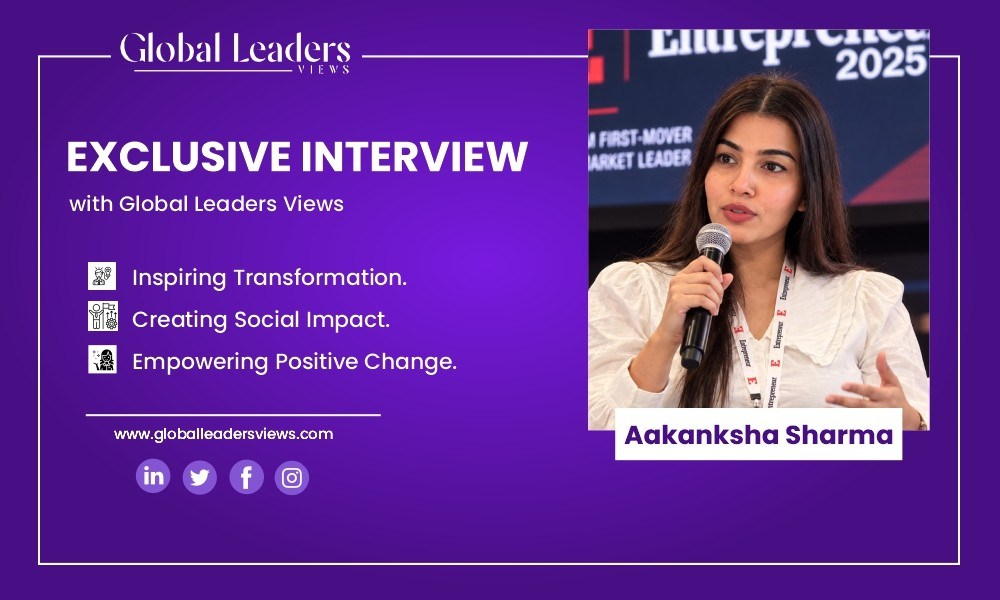

Artificial intelligence is changing how businesses operate, how decisions are made and how people interact with technology. Yet, as organisations race to adopt generative AI, one question remains essential: how do we ensure that innovation solves real problems and creates lasting value? For Aakanksha Sharma, Group Product Manager at Microsoft ISD UK, who also leads OPTVSN Journey, the answer begins with people.
As a cover leader of Global Leaders Views Magazine in The Most Influential Microsoft AI Product Leaders, 2026, Aakanksha represents a generation of technology leaders working at the intersection of enterprise innovation, responsible AI and human potential. Her professional journey, from software engineering and cloud technology to product leadership, reflects an understanding that successful technology is not defined by what it can do alone, but by the problems it helps people solve.
Her approach combines technical knowledge with commercial awareness, empathy and an appreciation of the challenges involved in turning promising ideas into products that work at scale. Alongside her corporate responsibilities, she has established OPTVSN Journey to help aspiring and practising product managers develop practical skills, professional confidence and the judgement required to lead in an increasingly AI-driven world.
An Unplanned Journey into Product Leadership
Aakanksha’s career did not begin with a carefully mapped ambition to become a product leader. Her early professional experience was rooted in software engineering, cloud technology and DevOps at Microsoft. These disciplines gave her a technical foundation and an appreciation of the systems that make modern digital products possible. However, an unexpected opportunity introduced her to a different dimension of technology.
A conversation with Graham, then Chief Product Architect, led to an invitation to write articles and practical guides for product managers. The assignment became a turning point: it drew her attention from how technology is built to why a product should exist, whose problem it solves and what success should look like.
She began to recognise that building technology and deciding what technology should achieve were two distinct but complementary responsibilities. Product management offered an opportunity to bring them together.
The transition demanded more than professional curiosity. During a challenging period in her personal life, Aakanksha made the decision to move to the United Kingdom and embrace a new role. The move meant adapting to an unfamiliar environment, a different working culture and colleagues with considerably more product management experience.
For someone entering the discipline without extensive formal experience, the challenge was substantial. Rather than waiting until she felt completely prepared, she committed herself to learning through observation, questions, mistakes and practical experience. Within six months, she was working alongside experienced peers, leading partnerships and developing strong customer relationships.
The experience shaped a principle that continues to influence her leadership: growth does not always begin with certainty. Sometimes it begins with a willingness to step into unfamiliar territory and learn quickly enough to make the opportunity count.
The Leadership Value of Listening
As Aakanksha progressed into product leadership, she discovered that technical expertise alone could not resolve the complexities of enterprise decision-making. Different departments have different priorities, customers measure success differently, and the people responsible for developing a product may not always share the perspective of those expected to use it.
Her work across manufacturing, telecommunications and energy has exposed her to these contrasting environments. Each industry brings its own operational pressures, established processes and expectations of reliability. Effective product leadership requires understanding these differences before proposing a solution.
Aakanksha’s approach centres on listening, clarity and empathy. Rather than relying on authority or job titles, she seeks to establish credibility through outcomes and build alignment around a shared objective. This involves making trade-offs explicit, understanding competing interests and helping teams recognise why a particular decision matters.
She also sees mentoring and training as important parts of leadership. Explaining a concept to another person requires more than knowing the answer; it demands the ability to communicate the reasoning behind a decision and encourage others to develop their own judgement.
For Aakanksha, confidence does not require pretending to know everything. It means being comfortable with uncertainty while remaining accountable for the next decision. This balance between humility and conviction is particularly valuable in AI, where capabilities are advancing rapidly and even experienced professionals must continue learning.
Generative AI and the Return of Product Judgement
Generative AI has accelerated the product development process. Teams can now create prototypes, explore concepts and demonstrate possible solutions far earlier than was practical just a few years ago. For Aakanksha, this offers a significant advantage: customers can interact with an idea and provide meaningful feedback before considerable resources are committed.
A working prototype often reveals more than an elaborate presentation. It exposes misunderstandings, highlights practical limitations and helps teams distinguish genuine customer interest from assumptions made during planning.
However, the ability to build quickly does not automatically lead to better products. In enterprise environments, the difficult questions often emerge after the initial demonstration. Is the underlying data reliable? Does the proposed solution fit the existing workflow? Can the organisation justify the cost? What happens when the system produces an incorrect answer?
Aakanksha believes these questions are central to responsible product leadership. A compelling demonstration may establish what is technically possible, but a dependable product must also work under real operating conditions. It must earn user confidence, provide appropriate safeguards and offer a sensible way forward when something goes wrong.
A convincing demonstration establishes what is possible. A dependable product must work in real operating conditions.
“Trust is not built by pretending an AI system is infallible; it is built by making failure understandable and recoverable.”
This principle captures the distinction between technological excitement and sustainable innovation. AI can increase the speed at which teams create solutions, but it also increases the importance of evaluating their consequences. Product leaders must determine not only whether a feature works, but whether it deserves to exist, how it should be used and what level of confidence users can reasonably place in it.
Finding Business Value Beyond the AI Label
As AI becomes a standard feature of enterprise technology, the temptation to add it to existing products is considerable. Yet Aakanksha’s approach begins with a more fundamental question: which decision or task needs to improve?
The answer may involve a process that employees have accepted as unnecessarily complicated, an approval that passes through several teams or technical knowledge that remains difficult to access. Such problems can create significant friction even when they are no longer noticed by the people working around them.
In energy and infrastructure settings, Aakanksha has explored how AI could help specialists interpret complex technical drawings. Her focus is on whether it can support faster, reliable understanding while preserving accuracy and human oversight. This remains an exploratory example, rather than a claim of a deployed solution or measured business results.
This distinction influences how she evaluates opportunities. Before treating an idea as a product initiative, she considers whether the necessary data is available, whether the expected benefit can be measured, who will own the outcome and what risks might emerge during adoption.
A business case should extend beyond the novelty of the technology. If an organisation cannot identify the problem, explain the intended improvement or assign responsibility for the result, it may not yet have a viable product opportunity.
The discipline is especially important in enterprise AI, where the consequences of a weak solution can extend beyond an individual user’s experience. A product may appear impressive in isolation yet fail to deliver value when integrated into established operations. The real test is whether it improves the work that matters.
From Promising Demonstrations to Scalable Products
Scaling AI introduces challenges that are easy to underestimate during early development. Enterprise data is rarely as clean or accessible as a prototype suggests. Models must be evaluated continuously, and teams need ways to identify declining performance, detect errors and determine when an output should not be trusted.
There are also organisational questions. Who maintains the product after launch? Who is accountable for its performance? How are computing and integration costs managed? Which actions may an AI system perform independently, and which require human approval?
For Aakanksha, these are not secondary considerations to address once the technology is ready. They are fundamental elements of product design.
Her engineering background helps her appreciate the technical realities, while her product leadership experience keeps her focused on customer needs, business processes and organisational ownership. This combination enables her to consider a product as a complete operating experience rather than a standalone model or feature.
The same thinking informs her approach to responsible AI. She sees responsibility not as an obstacle to innovation, but as a condition for its long-term success. Users should understand the AI’s role, have appropriate access to supporting evidence and know when they can correct or override its output. In higher-risk situations, human oversight must provide meaningful control rather than simply satisfy a procedural requirement.
A mature product strategy considers the recovery process as carefully as the ideal user journey. When AI makes a mistake, people need a clear way to recognise the problem and take appropriate action.
The Human Skills That Will Define AI Product Managers
As generative AI automates more routine activities, product managers may find it easier to draft specifications, analyse feedback and develop early prototypes. These efficiencies create opportunities, but they also raise expectations of what product professionals should contribute.
Aakanksha identifies judgement as a particularly important capability. AI can help generate options, but product managers remain responsible for choosing the right problem, rejecting unnecessary features and making difficult decisions about resources and priorities.
Technical fluency is equally valuable. Product leaders do not need to become the deepest technical specialists in every room, but they must understand enough about data, architecture, evaluation and failure modes to ask informed questions. Without that foundation, it becomes difficult to assess feasibility or recognise when a persuasive demonstration conceals a significant limitation.
Change leadership is another essential skill. Introducing AI often affects established responsibilities, working habits and professional expectations. Teams need to understand not only what is changing, but why the change matters and how it will affect their work. Empathy and clear communication can determine whether a technically capable product becomes part of everyday practice.
Finally, Aakanksha emphasises continuous learning. Her own movement from engineering into product strategy, AI and entrepreneurship demonstrates the value of remaining open to new disciplines. In a fast-moving industry, professional experience matters, but the ability to adapt may matter even more.
OPTVSN Journey: Turning Knowledge into Confidence
Among Aakanksha’s most meaningful achievements is the creation of OPTVSN Journey, an initiative shaped by her experiences mentoring professionals navigating career uncertainty.
Through these conversations, she encountered capable people affected by job losses, professional setbacks or difficult transitions. Many possessed substantial knowledge and experience, yet struggled to regain confidence or communicate their abilities effectively. The challenge was not always a lack of technical competence. Sometimes it was the absence of practical guidance, consistent support or someone willing to challenge their thinking constructively.
Aakanksha recognised that traditional learning could leave an important gap between understanding a concept and applying it in a real workplace. Product management requires professionals to defend prioritisation decisions, evaluate business cases, manage competing requirements and explain why a promising idea might fail. These capabilities develop through practice as much as through theory.
OPTVSN Journey was established to address that gap. Its approach combines practical assignments, personalised guidance, regular check-ins and accountability. Learners also receive access to an individualised WhatsApp support group available around the clock, whether they choose a self-paced e-course or a live programme.
The intention is to create a more connected learning experience in which participants have support beyond the moment they enrol. Rather than measuring progress solely through completed lessons or certificates, the initiative focuses on helping people strengthen their judgement, prepare for professional opportunities and become more confident in their decisions.
Aakanksha’s longer-term ambition is to build a full-stack transformation journey, taking learners from understanding product management to developing the skills required to lead products. The audience includes aspiring product managers, experienced professionals, founders and corporate teams.
Her engagement with students, including those outside major technology hubs, reinforces a belief that talent is widely distributed, while access to opportunity is not. By providing practical guidance and supportive professional networks, she hopes to help more people participate in the technology industry on their own merits.
Making Opportunity More Accessible
The wider significance of OPTVSN Journey lies in its focus on the person behind the professional development plan. Career transitions can involve uncertainty about identity, capability and future prospects. A new skill may open a door, but confidence and sustained support can help someone walk through it.
Aakanksha values the moments when learners begin expressing their ideas more clearly, approach interviews with greater conviction or make decisions they previously found intimidating. These outcomes reflect a form of impact that is difficult to capture through conventional business metrics but can influence the direction of a person’s life.
“Talent is everywhere, but opportunity is not.”
Aakanksha is clear that OPTVSN Journey is a collective undertaking. She extends her heartfelt thanks to the OPTVSN Journey team, Anupama, Neha, Sebastiano, Adhneya, Sujeet and Mritunjay, recognising their dedication and belief in the initiative. Their contribution reflects her understanding that meaningful work is rarely built by one person alone.
The Next Chapter: Agentic AI and Accountable Innovation
Looking ahead, Aakanksha is particularly interested in agentic AI: systems that can move beyond answering questions to performing actions across tools and workflows. This development could reshape enterprise products, but it also introduces new responsibilities for those designing them.
When an AI system can act, product teams must define what it is authorised to do, how its decisions will be monitored and when it should seek permission. They must also consider how users can intervene, reverse an action or recover from an error.
AI evaluation and economics are likely to become increasingly important disciplines as well. Organisations will need to understand not only how well a model performs, but what a task costs, whether the process has genuinely improved and whether the benefits justify the operational complexity.
Aakanksha expects the strongest results to come from organisations willing to redesign their workflows thoughtfully rather than simply place a chatbot on top of existing processes. The opportunity is to reconsider how work gets done, where human judgement is essential and where AI can provide dependable assistance.
For product leaders, this means that generating more output is not the ultimate objective. Direction, boundaries and accountability become increasingly important as technology gains greater capabilities.
A Legacy Built Around People
Aakanksha’s ambitions extend beyond the products she develops or the responsibilities she holds at Microsoft. She wants to continue creating AI solutions that address genuine business problems while growing OPTVSN Journey into a global platform for practical learning and product leadership development.
She is particularly interested in reaching people who have experienced setbacks, are changing careers or have considerable potential but limited access to professional networks. Her ambition is to create more opportunities for people to rebuild confidence, strengthen their capabilities and shape their own futures.
She also hopes to speak on a TEDx stage, sharing experiences that have challenged her confidence and changed her perspective. The aspiration is not to present a perfectly resolved account of success, but to speak honestly about the lessons and questions that accompany personal and professional growth.
Across enterprise AI and OPTVSN Journey, Aakanksha’s ambition is consistent: build useful products and help people make informed decisions. Her story reflects a leadership approach grounded in business understanding, accountability and practical support for others.
My own journey is still unfolding. But I don’t need to have everything figured out to help someone take their next step. I want the things I’ve had to learn the hard way to make someone else’s beginning a little less lonely.
— Aakanksha Sharma





Leave a comment