

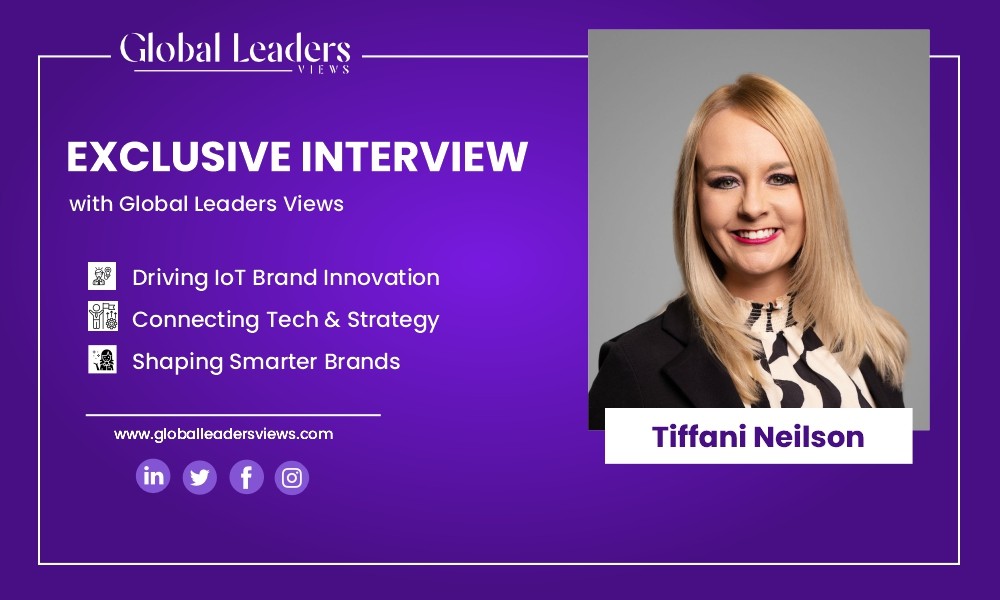
In a technology landscape where innovation moves faster than ever, marketing has become much more than promoting a product. It is about understanding complex technologies, identifying the problems they solve and creating meaningful conversations between innovators and the people who can benefit from their solutions. Few professionals understand this intersection as deeply as Tiffani Neilson, Chief Marketing Officer at IoT Marketing.
With more than two decades of marketing experience, Tiffani has built a career around connecting ideas with audiences. Her journey into the Internet of Things was not something she originally planned. Instead, it emerged from an unexpected opportunity that ultimately transformed the direction of her professional life.
Today, she is recognized for her work in IoT marketing, technology communications, brand strategy, events, content development and business growth, helping technology companies communicate complex ideas in ways that are understandable, relevant and commercially meaningful.
From Diverse Marketing Experiences to the World of IoT
Tiffani’s professional journey began across a broad range of industries, giving her exposure to different audiences, business models and approaches to communication. Her experience across events, trade shows, fashion, beauty, life coaching, branding and business development helped her develop something that would later become invaluable in technology marketing: the ability to understand people before communicating with them.
Her career took a significant turn when she was offered the opportunity to become Communications Director for an IoT startup in Las Vegas. At the time, the Internet of Things was completely new territory for her. Rather than seeing that unfamiliarity as a limitation, she became fascinated by the possibilities.
She was drawn to the intersection of technology, business and real-world problem-solving. The more she learned about IoT, the more she recognized that the technology itself was only part of the story. The greater challenge was explaining its value in language that business leaders, customers and decision-makers could understand.
That opportunity eventually led to her promotion to Vice President of Marketing, where she took on responsibility for messaging, positioning, marketing strategy and implementation. Her role also expanded into product development, including involvement in designing the company’s backend platform and developing partnerships with industry leaders, service providers, component suppliers and IoT platforms for integration.
The experience gave her a rare perspective. She was not simply marketing technology from the outside. She was gaining an understanding of how technology products were developed, how ecosystems were created and how difficult it could be to translate sophisticated technology into a compelling business proposition.
That experience continues to influence her approach today.
Leading IoT Marketing With Creativity, Agility and Resilience
As Chief Marketing Officer at IoT Marketing, Tiffani oversees marketing initiatives for the company as well as its clients. Her work sits at the intersection of IoT, AI, emerging technology, content marketing, events, public relations, branding and business development.
When describing her leadership philosophy, she keeps it remarkably simple: creative, agile and resilient.
Creativity enables her to identify opportunities, develop original ideas and help brands differentiate themselves in crowded markets. But creativity, in her view, cannot exist independently of business objectives. A strong creative vision must ultimately connect with measurable goals and meaningful outcomes.
Agility is equally important. Technology is constantly evolving and marketing strategies that work today may need to be reconsidered tomorrow. New platforms, emerging technologies and changing audience behaviors require marketers to remain curious and adaptable.
Then comes resilience. Business rarely follows a perfectly predictable path. Challenges, setbacks and unexpected changes are inevitable. For Tiffani, resilience means continuing to move forward while looking for opportunities within difficult circumstances.
This combination has shaped the way she approaches leadership and the way she works with clients, partners and audiences across the technology ecosystem.
Turning Complex Technology Into Stories People Understand
One of the biggest challenges facing technology companies is not necessarily developing innovative solutions. It is communicating why those solutions matter.
IoT, artificial intelligence, robotics, connectivity, edge computing and other emerging technologies can be highly technical subjects. Yet customers and business leaders do not always want to hear about technology for technology’s sake. They want to know what problem it solves, how it affects their business and what outcome they can expect.
This is where Tiffani’s marketing philosophy becomes particularly relevant.
Rather than allowing technologists to dominate the conversation with technical specifications, she encourages brands to focus on the customer and the business challenge. The technology should support the story, not become the entire story.
At IoT Marketing, this approach combines knowledge of emerging technologies with expertise in marketing, PR, content, events and production. The objective is to help companies communicate their solutions in a way that creates awareness while also providing genuine value to their audiences.
For Tiffani, effective technology marketing is ultimately about translation: translating technical capabilities into business value and transforming complicated ideas into conversations that people can engage with.
Building an Ecosystem Through Events and Strategic Partnerships
Tiffani’s work extends far beyond traditional marketing campaigns. She has played a significant role in creating events and content platforms designed to bring technology leaders, innovators and business executives together.
Through IoT Marketing’s events, more than 100,000 decision-makers have been reached globally, while more than 100 virtual events have featured experts and leaders from organizations including Microsoft, Hitachi, Google and Walmart, among others.
She also created the Tech Scope Connect content hub and cohosts the Tech Scope News podcast with IoT Marketing CEO Johannes Beekman.
These platforms reflect a fundamental belief in the importance of ecosystems.
“IoT doesn’t just take a village. It takes an ecosystem.”
That philosophy captures much of what Tiffani brings to technology marketing. Innovation rarely happens in isolation. It requires relationships between technology providers, customers, industry experts, service providers, platforms, partners and communities.
Events provide an environment where those relationships can develop naturally. They allow companies to share expertise, understand market trends, demonstrate thought leadership and engage directly with potential customers.
For Tiffani, strategic partnerships are equally powerful because they allow complementary audiences, expertise and resources to come together. When those relationships are built around genuine value rather than simply exposure, they can create opportunities that would be difficult for a company to achieve alone.
Learning Through Conversations With Technology Leaders
Perhaps one of the most interesting aspects of Tiffani’s work is that her role as a marketer has also made her a continuous learner.
Every conversation with a speaker, technology executive or event participant becomes an opportunity to understand a new problem, technology or market.
When she began developing Industry Insights Webinars, she initially viewed IoT through a relatively narrow lens. As she explored different industries, however, she began seeing how broad the technology landscape truly was.
IoT was not evolving independently. It was increasingly intersecting with artificial intelligence, robotics, drones, connectivity, quantum technology and numerous other emerging fields.
That realization has influenced the direction of her content and events. Instead of treating technology as a collection of isolated categories, she sees a much larger connected ecosystem where different innovations increasingly work together.
It is also one of the reasons she remains passionate about the industry. There is always another question to investigate, another technology to understand and another business challenge to explore.
The Changing Role of AI in Marketing and Brand Communication
Artificial intelligence is now transforming the marketing landscape and Tiffani sees the shift as much broader than simply using AI to create content.
AI is changing how people search, discover information and interact with brands. Traditional search behavior is increasingly being complemented by conversational experiences in which people ask AI systems questions and expect direct, useful answers.
For marketers, this means visibility increasingly depends on more than traditional search rankings. Brands need authoritative, useful and clearly structured content that genuinely answers the questions their audiences are asking.
This evolution is also changing the role of content itself. Instead of producing content simply to fill a website or target keywords, businesses need to think about whether their content demonstrates expertise, addresses real customer challenges and provides information that people can trust.
Yet Tiffani does not believe technology eliminates the human element of marketing. In fact, she sees authenticity becoming even more important.
AI can accelerate processes and help marketers work more efficiently, but creativity, experience, relationships and genuine perspective remain difficult to replicate. A memorable brand still needs a human point of view.
Resilience in the Face of Uncertainty
One of the defining moments in Tiffani’s leadership journey came in early 2020.
Before the full impact of COVID-19 was understood, she recognized the potential threat the pandemic could pose to the technology events industry. Trade shows and conferences were facing cancellations and postponements, creating serious challenges for companies that relied on those platforms to build awareness and generate opportunities.
Instead of waiting for circumstances to dictate the outcome, Tiffani and her team moved quickly toward virtual events.
They created Industry Insights Webinars to connect businesses seeking connected solutions with relevant experts and technology ecosystem partners. The transition allowed the organization not only to continue operating but also to develop a virtual B2B event model that continued to thrive beyond the initial disruption.
The experience reinforced one of her strongest leadership lessons: resilience is not simply about surviving change. It is about recognizing change early enough to respond and having the courage to adapt before circumstances force you to.
A Career Defined by Influence, Learning and Recognition
Tiffani’s career has also been marked by professional recognition. She has been named among influential business and marketing leaders by several publications and organizations, including recognition as one of the 10 Most Influential Women in Marketing, one of the 10 Most Inspiring CMOs and among inspiring and influential business leaders.
She has also had opportunities to speak at major technology events, including Mobile World Congress in Las Vegas and IoT Tech Expo in Fort Lauderdale.
For her, however, recognition is not the destination. The greater reward is being part of conversations that influence how organizations understand technology and make decisions about innovation.
Her experience attending Mobile World Congress Barcelona provided another perspective, allowing her to witness the enormous scale of the global connectivity and technology ecosystem.
These experiences have reinforced the importance of staying curious. The technology industry moves too quickly for anyone to assume they have learned everything.
Encouraging the Next Generation of Women in Technology Marketing
For women aspiring to build leadership careers in marketing and technology, Tiffani’s advice begins with authenticity.
In an environment increasingly influenced by AI-generated content and automated communication, having a distinctive human perspective matters. Personal experience, opinions, creativity and individual voice can become powerful differentiators.
She also encourages aspiring leaders to become involved. Industry events, panels, working groups, committees, conferences and professional communities create opportunities to meet people, exchange ideas and contribute to important conversations.
Above all, she believes in continuous learning.
Technology changes rapidly and remaining relevant requires curiosity. Reading, attending events, listening to podcasts, taking courses and speaking with people who have different expertise can all expand a professional’s perspective.
Perhaps most importantly, she encourages people not to wait until they feel completely ready. Sometimes the opportunity comes first and confidence develops through experience.
Looking Ahead to the Future of IoT and Emerging Technology
Tiffani’s next chapter continues to focus on connecting people, technology and ideas.
Together with Johannes Beekman, she is working toward launching a new brand designed to bring events and content together into a cohesive destination. The vision is to make conversations around IoT, AI and emerging technologies easier for audiences to discover, understand and engage with.
Another important milestone is Summit of Things 2026, a three-day virtual event scheduled for October 27–29, bringing together technology leaders, innovators and business professionals to explore IoT, AI, edge computing, connectivity, cybersecurity and other technologies shaping the connected future.
The larger ambition behind this work is clear: technology should not simply be discussed. It should be understood.
For Tiffani Neilson, marketing is the bridge that helps make that understanding possible. Her career demonstrates how creativity can coexist with technology, how strategic communication can simplify complexity and how strong relationships can turn an industry into an ecosystem.
As the worlds of IoT, AI and emerging technology continue to converge, her role becomes increasingly relevant. She is not simply marketing technology; she is helping shape the conversations around how technology is understood, adopted and connected to real-world business opportunities.
And perhaps that is what makes Tiffani’s journey particularly compelling. Her career began with an unexpected introduction to IoT, but what followed was much more than a transition into another marketing sector. It became a continuous journey of discovery—one shaped by curiosity, adaptability, resilience and an enduring belief that the most powerful innovations become meaningful when people understand why they matter.



Leave a comment