

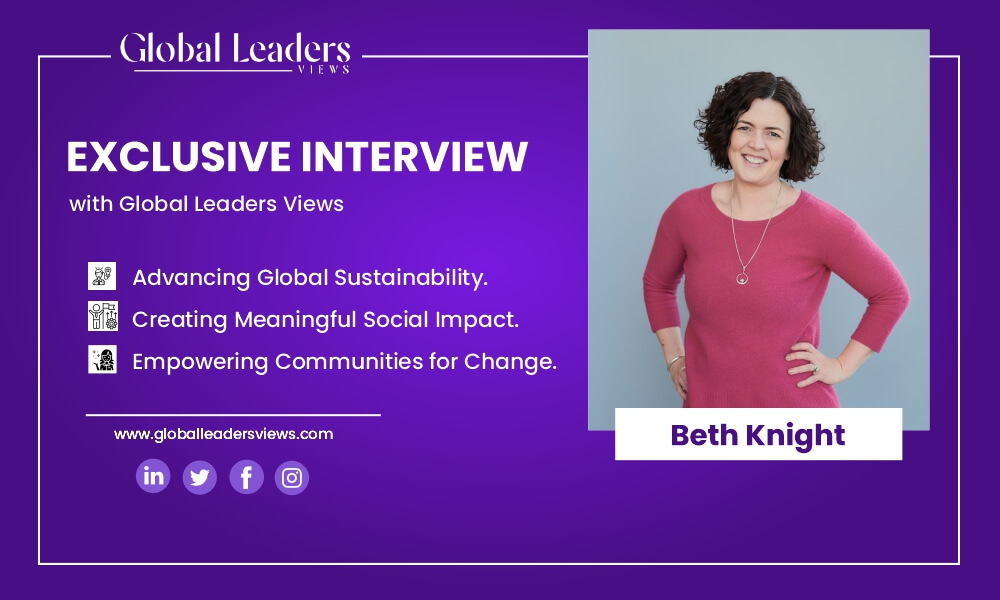
In February 2022, when war broke out in Ukraine, Beth Knight assumed the role of ‘Incident Commander’ of the largest corporate humanitarian response effort mobilized to-date, whilst also preparing with her family to welcome displaced refugees into her own home. That contrast captures what is most unusual about her career: the same leader who can mobilise large institutions at speed is also willing to absorb the consequences of crisis into her own daily life.
Over more than two decades, Beth has built a career that moves between corporate boardrooms, financial services, humanitarian response and ‘tech for good’. Recognised as Great British Businesswoman of the Year 2022/23, she has held senior roles at EY, Amazon and Lloyds Banking Group, while also serving as Chair of Save the Children UK’s Corporate Advisory Board, a board member of the British Tourism Authority and a Senior Associate at the University of Cambridge Institute for Sustainability Leadership.
There are plenty of senior executives who speak fluently about purpose, resilience and systems change. What distinguishes Beth is that she has a long record of redesigning real systems so they work better for people who are excluded, overlooked or left exposed when institutions fail them. Her story is not one of abstract ideals. It is about what happens when operational rigour, commercial acumen and social purpose are brought together under pressure.
Purposeful leadership amidst crisis
Beth’s work on Ukraine humanitarian aid is the clearest expression of that approach. At Amazon, she oversaw a crisis response effort that grew into a 250-person taskforce, established major aid hubs in Poland and Slovakia, and expanded an initial $USD 10 million commitment to over $USD 75 million by the end of 2022 – with support spanning financial aid, product donations, logistics support and AWS cloud computing credits for humanitarian organisations.
Under her leadership, more than 2 million essential aid items were distributed at scale. The response was not only about moving goods quickly, but also about translating a global company’s infrastructure into something useful for refugee families, charities and frontline organisations working across multiple borders.
Her work also extended beyond emergency relief into longer-term recovery. Supporters point to her role in helping develop BecomingX Ukraine, a digital learning platform designed to help displaced Ukrainians build employability skills and access work, which was later adopted by the Ukrainian government. That detail matters because it reflects a pattern seen throughout Beth’s career: immediate support is important, but durable recovery requires systems, opportunity and agency.
Yet, Beth’s professional achievements are only half the story. Through the ‘Homes for Ukraine’ scheme, she opened her own home to six refugees over the course of three years. In one case, she took in a mother and daughter at just 48 hours’ notice when their original hosts faced a personal emergency and the family risked homelessness. Later, she converted her living room into a bedroom so another family could stay together.
What followed was not a symbolic gesture but sustained, practical support. She worked with local schools and public services to secure English language tuition, extra-curricular activities and school placements, helped fundraise for a laptop so a mother could study and seek work, and supported the reunion of separated family members after years apart. She also helped one woman, a survivor of domestic abuse, navigate divorce and move towards independent housing and employment.
For readers, this is where the story stops being a conventional profile of a sustainability executive and becomes something more textured. The same person shaping cross-border humanitarian logistics was also handling school runs, children’s clubs, bedding, paperwork and emotional support. It shows Beth not as a distant architect of purpose-led strategy, but as someone willing to carry its human weight herself.
A philosophy formed early-on
Beth’s example resonates so strongly because it was not an isolated act of leadership. Earlier in her career, she was already making choices that pointed in the same direction.
During her time with Accenture Development Partnerships, she took a voluntary 40 per cent pay cut to work with Oxfam, restructuring operational systems so more money could be redirected to frontline humanitarian work. The project freed more than £230,000 of in-year funding and reduced ongoing costs by around 20 per cent. For Beth, it was a pivotal moment in her career which reinforced a belief that operational excellence and social impact should never be treated as separate agendas.
While living in Chennai on an Accenture engagement, she also built a community donation and volunteering initiative after seeing local need at close quarters. She persuaded colleagues to channel unspent per diem allowances into a fund that bought books, clothing, sports equipment and other essentials for a nearby orphanage, while also organising regular volunteering visits that supported more than 150 children.
This was something Beth did quietly with support from her Indian colleagues and was not a headline-grabbing intervention which reveals something important about how she works. Beth listens and notices where systems leak value, where resources sit idle and where people and institutions can be persuaded to do more than they currently think possible.
The ‘long game’ of impact
That instinct is also visible during her time in Kenya with Shining Hope for Communities (SHOFCO), where she served as Chief Programmes Officer from 2017 to 2018 on secondment from EY. SHOFCO was already doing vital work across informal settlements in healthcare, education, water and sanitation, women’s empowerment and gender-based violence response. Beth joined at a moment of rapid growth and increasing operational complexity.
According to Kenyan colleagues, she helped strengthen schools, expand medical clinic reach, fortify water pipelines, improve impact reporting and build a three-year growth strategy aligned with the UN Sustainable Development Goals. Her contribution has been described as ‘pivotal’ by SHOFCO’s CEO, Kennedy Odede, in supporting the charity secure the 2018 Hilton Humanitarian Prize.
The systems she helped shape did not disappear when she left. SHOFCO has since grown into Kenya’s largest grassroots organisation, reaching more than 2.5 million people annually across 84 sites in 75 counties. That scale gives weight to a principle Beth appears to return to repeatedly: real leadership is not about being indispensable, but about building institutions and support processes that continue to deliver after you have moved on.
What makes her Kenya work especially compelling, though, is the same tension between scale and intimacy seen later in her support for displaced Ukrainians. Her commitment to the country did not end with the formal role; to this day Beth’s family sponsors two young girls through their schooling and she has a long-standing relationship with SHOFCO and the communities it supports.
In a context where the stakes were different, Beth recognized that the underlying questions were the same: how do you build systems that are accountable, resilient and rooted in the people they are meant to serve?
Inclusion as institutional strategy
Beth’s more recent work at Lloyds Banking Group shows how that philosophy translates into mainstream British business. As Head of Social Sustainability in Business & Commercial Banking, she has helped turn inclusive entrepreneurship from a series of good initiatives into a more strategic, data-led and system-level agenda tied directly to sustainable finance growth.
At Lloyds, Beth has overseen a £GBP multi-million portfolio of activity spanning Black entrepreneurship, disability inclusion and women’s economic participation. Under her leadership, the bank has provided more than 16,000 hours of targeted support to inclusive business programmes, while her championing of disability helped Lloyds to become a founding signatory of the Disability Finance Code and led to the UK’s first dedicated business accelerator for disabled founders in partnership with social enterprise Foundervine. This was delivered amid growing anti-DEI sentiment in the external market, and alongside her work to strengthen policies, processes and team capabilities so the impact of this agenda could outlast her tenure.
This is a revealing part of Beth’s story because it places her firmly at the heart of effecting positive and lasting change through business, rather than at its edges. Her case for inclusion is not framed as charity; it is about widening participation, correcting structural market failures, improving access to finance and ultimately strengthening economic resilience.
Building the next generation
Alongside her executive roles, Beth has consistently invested in leadership education and pipeline-building. Through the University of Cambridge Institute for Sustainability Leadership, where she has served since 2016 as a Senior Associate on executive programmes and corporate leaders’ groups, she has helped educate and strengthen the impact of thousands of sustainability professionals.
Her academic impact ranges from business management course design to sustainable finance research, from published organisational psychology thought leadership to establishing an “AI for Good” alumni network. In parallel, as a core member of the trailblazer group behind the UK’s first Corporate Responsibility and Sustainability Apprenticeship standard, she has helped open up sustainability careers to apprentices from under-represented and non-traditional backgrounds.
This strand of Beth’s work may be less dramatic than humanitarian aid, but it is central to understanding the breadth of her influence and expertise. Beth is not only a sustainability leader herself; she is helping shape the people who will lead after her, from senior executives to early-career apprentices. That focus on talent pipelines, accessible leadership opportunities and practical capability-building adds another layer to the professionalism of sustainability that her agency for change represents: not a specialist silo, but a discipline that must spread through institutions, sectors and generations
The real change agent
Any one of the examples uncovered about Beth Knight could sustain a strong leadership profile on its own. But together, they reveal something more distinctive. The most interesting thing about Beth is not simply that she has worked across corporate sustainability, humanitarian aid, entrepreneurship and education. It is that she approaches all of them in fundamentally the same way.
Again and again, she moves towards complexity. She enters spaces where institutions are under strain, where needs are urgent and where organisations could easily default to symbolism or inertia. Then she does the less glamorous work of redesigning structures, building partnerships, finding overlooked resources and staying close enough to people affected by those decisions to understand whether the system is actually working.
That is what makes her such a strong change agent. There is scale in her story, but also texture in its impact. There is corporate credibility, but also moral seriousness. And there is a clear lesson for business leaders far beyond the sustainability profession: purpose-led leadership is credible only when it holds together both strategically and personally.
Beth’s career shows that sustainable business is not defined by slogans, frameworks or reputational positioning. It is defined by whether leaders can build purposeful institutions that endure, create access where systems exclude or markets fail, and stand close enough to human consequences to stay accountable for what they claim to value.


Leave a comment