





Global Leaders Views explores how robotics and automation are transforming industries in 2026, reshaping the way businesses operate, manufacture products, and deliver services. Across manufacturing, healthcare, logistics, agriculture, and other sectors, companies are adopting advanced technologies to improve productivity, reduce errors, and manage operational costs. Artificial intelligence (AI), machine learning, and smart robotic systems are making machines more capable of performing complex tasks with greater accuracy. As businesses respond to growing competition and changing customer expectations, robotics and automation are becoming important drivers of industrial innovation and business growth.
The Growing Role of Robotics in Modern Industries
Robotics has moved beyond traditional factory assembly lines. Today, robots can inspect products, move materials, assist medical professionals, and support warehouse operations. These developments help businesses improve speed while maintaining consistent quality.
Manufacturing companies use industrial robots for welding, painting, packaging, and assembly. In healthcare, robotic systems support certain surgical procedures and rehabilitation activities. Meanwhile, agricultural robots can assist with planting, crop monitoring, and harvesting.
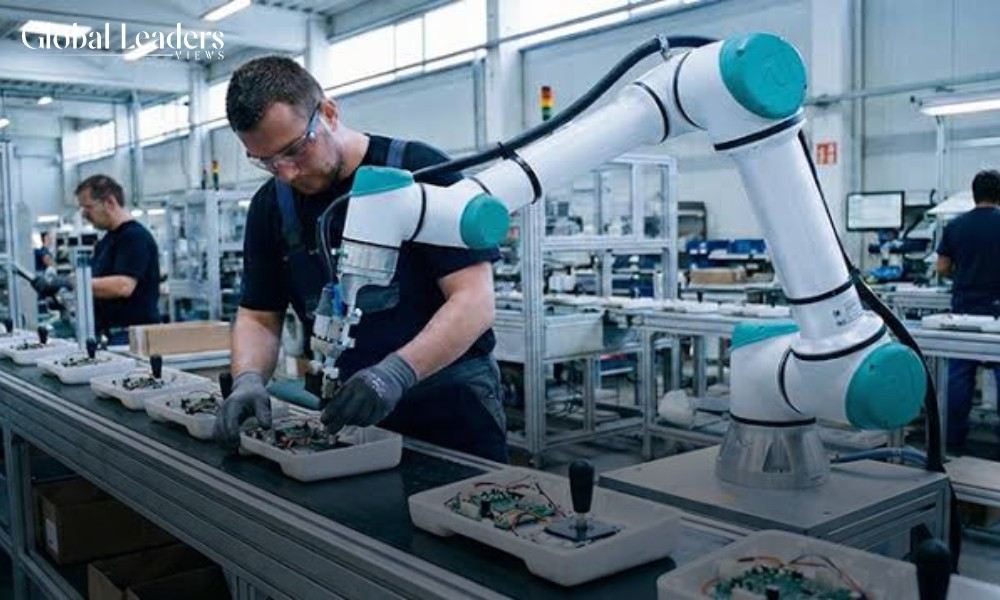
The future of the robotics industry will depend on how effectively organizations combine automation with human expertise. Rather than replacing every human task, many systems are designed to support workers and allow them to focus on more complex responsibilities.
How Artificial Intelligence Is Making Robots Smarter
Artificial intelligence is expanding what robots can accomplish. Traditional robots generally follow programmed instructions, while AI-powered robots can use sensor data, cameras, and software models to recognize objects and respond to changing conditions.
For example, AI-enabled robots in warehouses can identify products, navigate working areas, and help organize inventory. In manufacturing, machine vision systems can detect defects that may be difficult to identify consistently through manual inspection.
These capabilities are contributing to the development of some of the most advanced robotics technologies, including autonomous mobile robots, collaborative robots, and humanoid robots.
However, businesses must also consider cybersecurity, data protection, system reliability, and implementation costs before adopting these solutions.
Key Industries Benefiting From Robotics and Automation
1. Manufacturing
Robots help manufacturers increase production speed, improve precision, and reduce repetitive manual work. Automated inspection systems also help identify quality issues earlier, reducing waste and production delays. By integrating robotics with smart manufacturing systems, companies can improve production planning and respond more effectively to changing demand.
2. Healthcare
Robotic technologies support surgical procedures, rehabilitation, laboratory automation, and hospital logistics. These systems can improve precision and help healthcare professionals manage demanding workloads. However, their effectiveness depends on the application, appropriate training, and proper medical oversight.
3. Logistics and Warehousing
Automated guided vehicles and autonomous mobile robots move goods, organize inventory, and support order fulfillment. Businesses can use these technologies to improve warehouse operations, reduce repetitive handling tasks, and respond more efficiently to customer demand.
4. Agriculture
Robotics supports precision farming through automated planting, targeted spraying, crop monitoring, and harvesting. These applications can help farmers use resources more efficiently, monitor crop conditions, and address labor shortages.
Challenges Facing the Robotics Industry in 2026
Despite its benefits, robotics adoption comes with challenges. High initial costs, maintenance requirements, integration difficulties, and shortages of skilled workers can make implementation difficult, particularly for small and medium-sized businesses.
Companies also need to understand how automation may change existing jobs. Training employees in robotics maintenance, programming, data analysis, and system supervision can help workers adapt to new responsibilities.
Industry associations, technology providers, and research institutions can support adoption by sharing best practices, developing standards, and encouraging workforce training. Robotics case studies can also help businesses understand real-world results, implementation costs, and potential risks before investing in new technologies.
Organizations researching industry developments can review a state of robotics industry report for 2026 when available from credible research providers and relevant industry associations. These resources can offer insights into investment trends, emerging applications, and adoption challenges. Similarly, a robotics press release from a manufacturer or technology company may provide updates about new products, partnerships, and automation projects.
What Is the Future of the Robotics Industry?
The future of the robotics industry is likely to involve greater collaboration between humans and intelligent machines. Improvements in sensors, AI, computer vision, and robotic mobility are creating opportunities for more flexible automation across different sectors.
Businesses are also exploring robots that can perform multiple tasks instead of operating within a single fixed process. Collaborative robots, often called cobots, are designed to work alongside people in suitable environments, helping improve flexibility and productivity.
However, wider adoption will depend on affordability, safety, reliability, and measurable business value. Companies evaluating new technologies should examine practical applications, review credible industry research, and assess whether automation solves a specific operational problem.
Robotics and Automation: Building the Industries of Tomorrow
Robotics and automation are transforming industries in 2026 by improving productivity, supporting precision, and helping businesses manage complex operations. From smart manufacturing and healthcare to logistics and agriculture, these technologies are creating new opportunities for innovation and growth.
The long-term success of robotics will depend not only on technological progress but also on responsible implementation, employee training, and effective human-machine collaboration. Businesses that adopt automation strategically can build more adaptable operations, improve their competitiveness, and prepare for the changing demands of the global economy.
















Leave a comment